


 Revenue Cycle Management
 03-Jun-2026
Most healthcare practices and finance teams do not lose revenue because they stop billing. They lose revenue because they stop watching. Every day that an unpaid claim sits untouched, or a delinquent account goes unnoticed, or a payer denial goes unanswered, money quietly walks out the door.
The solution is not more billing staff. It is better visibility. Specifically, it is tracking the right accounts receivable metrics consistently and acting on what they reveal.
This blog breaks down 5 high-impact AR metrics that every finance leader, RCM director, and practice manager should be monitoring in real time. Whether you manage a multi-specialty hospital, a single-physician practice, or a dental group, these numbers are the difference between a healthy revenue cycle and one that bleeds cash silently.
Strong accounts receivable management services are not simply about sending invoices and following up. They are about creating a data-driven feedback loop that reveals exactly where money is moving – and where it is stalling.
AR metrics give you that feedback loop. They translate thousands of individual transactions, claims, and patient balances into clear, actionable signals. They tell you whether your collections team is keeping pace with billing volume, whether your payers are performing within contract terms, and whether your credit policies are creating risk you have not yet noticed.
Without these metrics, AR management becomes reactive. Teams scramble at month-end, chase accounts that have already gone cold, and miss early indicators of systemic problems. With them, the entire revenue cycle becomes proactive – and proactive cycles collect significantly more.
According to the Medical Group Management Association (MGMA), the top-performing medical practices maintain a DSO below 30 days and keep their over-90-day AR below 10% of total AR. (Source: MGMA 2023 DataDive Cost and Revenue Report.)
The question is not whether you should track AR metrics. It is whether you are tracking the right ones – and acting on them fast enough.
If there is one number that captures the health of your RCM billing services more than any other, it is Days Sales Outstanding.
DSO measures the average number of days it takes your organization to collect payment after a service is rendered or an invoice is issued. It is the fundamental clock of your revenue cycle – how fast does money owed actually become money in hand?
|
Formula: DSO = (Accounts Receivable / Total Credit Sales) x Number of Days |
For example, if your practice carries $500,000 in AR and generated $1,000,000 in credit sales over 30 days, your DSO is 15 days. That is excellent. If your AR is $500,000 against $100,000 in monthly credit sales, your DSO climbs to 150 days – a serious warning sign.
A high DSO is not just a collections problem. It is a cash flow problem, a staffing problem, and often a billing quality problem all at once. In an RCM billing services context, elevated DSO frequently traces back to:
Industry benchmark: A DSO under 40 days is considered healthy for most healthcare practices. High-performing practices often achieve DSO in the 25–35 day range. (Source: Healthcare Financial Management Association, HFMA 2024 Revenue Cycle Benchmarking Report.)
DSO tells you how long collections are taking. CEI tells you how well your team is actually collecting. These are two very different questions – and many organizations mistakenly rely on DSO alone.
The Collection Effectiveness Index is the truest performance indicator available to revenue cycle management services teams because it separates process efficiency from billing volume fluctuations. DSO rises when billing volume spikes, even if your team is performing perfectly. CEI does not. It measures the percentage of collectible AR that your team actually recovered within a defined period.
|
Formula: CEI = (Beginning AR + Credit Sales - Ending Total AR) / (Beginning AR + Credit Sales - Ending Current AR) x 100 |
A CEI of 100% means you collected everything collectable. A CEI of 70% means roughly 30% of what should have been collected was not. For most practices, a CEI above 80% is the target, with top performers exceeding 90%.
A declining CEI almost always points to one of three root causes: a denial management gap, an understaffed follow-up team, or a self-pay collection weakness. The good news is that CEI is a precise enough metric to help you isolate which problem you are actually dealing with.
Pairing CEI with active denial management services is one of the most effective ways to lift collections performance. When denials are appealed quickly, accurately, and systematically, they re-enter the collectible AR pool – and your CEI climbs.
Average Days Delinquent measures how many days past due your outstanding invoices or claims are sitting, on average. While DSO captures total collection time, ADD isolates the delinquency portion – it tells you not just how long collections are taking, but how far behind you actually are.
|
Formula: ADD = Days Sales Outstanding (DSO) - Best Possible Days Sales Outstanding (BPDSO) |
Best Possible DSO represents the fastest theoretically achievable collection time under ideal conditions. If your actual DSO is 55 days and your BPDSO is 30 days, your ADD is 25 days. That 25-day gap represents real delinquency risk.
ADD is particularly powerful when tracked by payer class or customer segment. A high ADD for a specific commercial payer often signals a billing or credentialing issue specific to that payer. A high ADD across self-pay accounts may indicate that your Patient Statement Service workflow needs revision – clearer statements, earlier delivery, or better follow-up timing.
Research from the American Academy of Family Physicians found that the probability of collecting a receivable drops by more than 50% once it passes the 90-day threshold. (Source: AAFP Practice Management Resources, 2022.) ADD gives you the early warning before you reach that cliff.
The AR Turnover Ratio measures how many times your outstanding receivables are collected and replaced within a given period. Think of it as the velocity of your collections cycle. The higher the ratio, the faster your accounts receivable management services are converting credit into cash.
|
Formula: AR Turnover Ratio = Net Credit Sales / Average Accounts Receivable |
If your practice generates $1,200,000 in annual net credit sales and carries an average AR of $100,000, your AR Turnover Ratio is 12 – meaning you effectively turn over your receivables 12 times per year, or roughly once per month.
A declining AR Turnover Ratio is a forward-looking warning sign. It often appears before DSO or CEI deteriorate significantly, making it one of the best leading indicators available. Common causes of a falling AR turnover ratio include:
Track this ratio monthly rather than quarterly. By the time a quarterly report reveals a problem, you have already lost three months of collections momentum.
If there is one AR tool that experienced outsource accounts receivable services providers examine first when assessing a new client's revenue cycle health, it is the aging report.
The AR aging report breaks down all outstanding balances by time bucket – typically 0–30 days, 31–60 days, 61–90 days, and 90-plus days. It shows you not just how much you are owed, but how old the debt is – and how at-risk each slice of your AR truly is.
From high DSO to aging receivables piling up past 90 days, IntelliRCM's RCM billing services are designed to close the gap between what you bill and what you collect.
For practices using dental rcm services, the aging report takes on even greater importance because dental reimbursement cycles are faster and more variable than medical. When a dental AR aging report shows a swelling 90-plus-day bucket, it frequently signals either a credentialing lapse or a fee schedule mismatch – both of which are fixable problems that improve dramatically when caught early.
Best practice: Run your aging report weekly, not monthly. In a busy practice, a month of unmonitored AR can let hundreds of claims cross the 90-day threshold silently.
Tracking any one of these metrics in isolation gives you a data point. Tracking all five together gives you a picture of your revenue cycle that is diagnostic, not just descriptive.
Here is how the five metrics interact as a system:
Build a weekly AR dashboard that maps all five metrics side by side. When you see two or more moving in the wrong direction at the same time, treat it as an operational alert – not a month-end footnote.
Tracking five metrics on a spreadsheet is a start. Turning those metrics into real collections momentum requires the right operational backbone behind them.
IntelliRCM is built for exactly that. With over two decades of revenue cycle expertise, IntelliRCM delivers end-to-end revenue cycle management services that are performance-accountable at every stage. Whether you need to reduce a stubborn DSO, improve CEI across a multi-payer environment, or recover aging receivables that have been sitting in the 90-plus-day bucket for too long, IntelliRCM brings the team, technology, and process discipline to move the numbers.
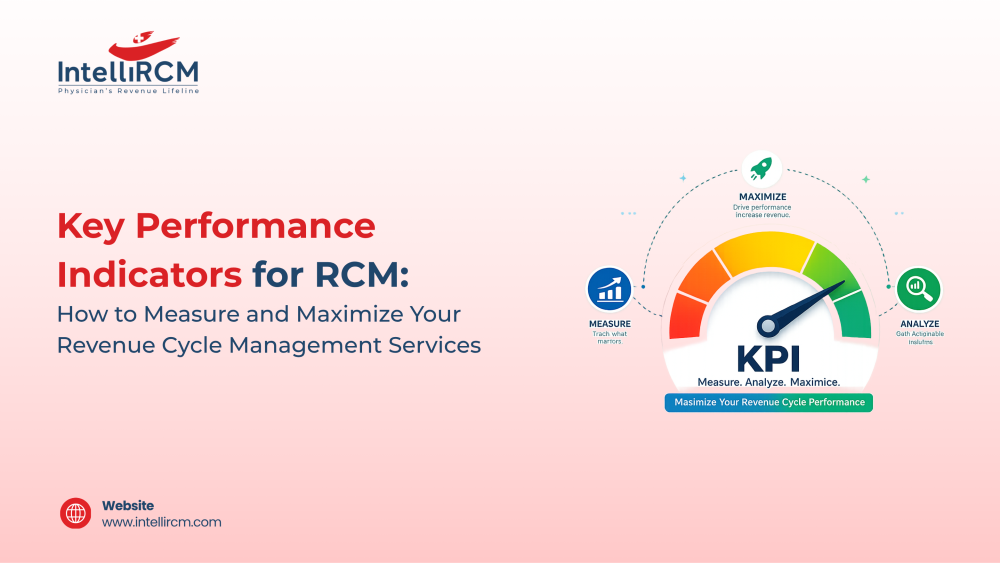
Track key RCM KPIs like denial rate, AR days, and collections to improve cash flow. Learn how expert RCM services boost revenue performance—get started today.
Read Full GuideYour revenue cycle does not fail all at once. It erodes slowly, claim by claim, denial by denial, aging bucket by aging bucket. The five metrics covered in this blog – DSO, CEI, ADD, AR Turnover Ratio, and AR Aging – exist precisely to interrupt that erosion before it becomes a crisis.
The practices and organizations that consistently outperform their peers in collections are not the ones with the most billing staff. They are the ones with the clearest visibility. They watch their numbers weekly, interpret them as a system, and act decisively when the patterns shift.
You now have the framework. The next step is building it into your weekly operations – or partnering with a team that already has it built in.

Virtual assistant technology has the potential to revolutionize patient engagement in healthcare, improving access to care, enhancing patient satisfaction, and ultimately driving better health outcomes. By embracing these innovative technologies and addressing the associated challenges, healthcare providers can unlock the full potential of virtual assistants to transform the patient experience and improve the quality of care.
Read More
The CAQH Network plays a vital role in improving the efficiency and accuracy of provider enrollment and credentialing. By leveraging the capabilities of the CAQH Network and integrating it effectively into their RCM processes, healthcare providers can streamline operations, reduce administrative burden, and improve access to care. As the healthcare industry continues to evolve, the CAQH Network will remain an essential tool for navigating the complexities of provider enrollment and credentialing.
Read More
CPT codes, CMS policy shifts, and revenue cycle updates are reshaping billing in 2026. Read the full guide and protect your medical practice revenue today.
Read More