
 Dental Billing
 10-Jun-2026
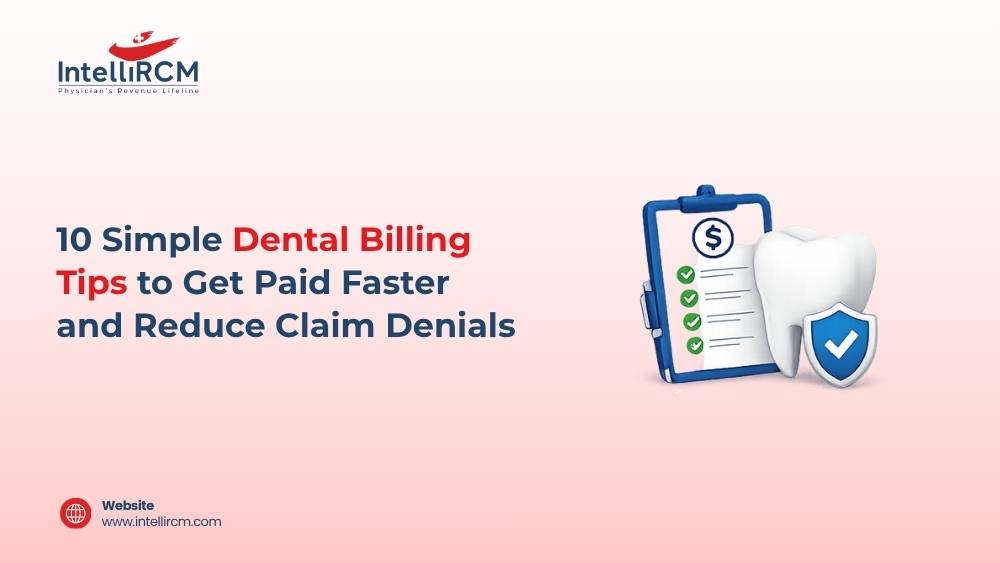
If your dental practice is facing late reimbursements, mounting claim denials, and confused patients who never pay their balances, you are not alone. Dental billing is one of the most complex and time-consuming administrative functions in a modern dental office. According to the American Dental Association, claim denial rates across dental practices range between 5% and 10% on average, and improper billing is responsible for millions of dollars in lost revenue every year (source: American Dental Association, 2023).
The good news? Most billing problems are preventable. With the right systems, trained staff, and a clear process, your practice can dramatically reduce denials, accelerate cash flow, and spend more time focused on patient care. Whether you handle billing in-house or are considering bringing in a dental billing specialist, the tips in this guide will help you build a stronger, more efficient revenue operation.
Before we get into the tips, it helps to understand why getting dental billing right matters so deeply to your practice's financial health.
Effective dental billing is the backbone of a healthy Revenue Cycle Management Services strategy. When your billing process is clean and consistent, you collect more of what you earn, reduce the administrative burden on your front desk, and improve the patient experience from check-in to payment.
Practices that invest in strong billing systems also tend to see higher patient retention rates. When patients receive clear, accurate billing statements and flexible payment options, trust increases. On the operational side, fewer denied claims mean less time spent on appeals, less write-off revenue, and more predictable cash flow month after month.
Simply put, strong dental billing is not just an administrative task. It is a core business function that directly affects your bottom line.
Knowledge is power. Every member of your staff, from the front desk to the back office, should understand these terms. When your team is fluent in dental billing vocabulary, they communicate more effectively with both patients and insurance carriers. This reduces misunderstandings and ensures that claims are filed the first time correctly.
One of the single most common reasons dental claims get denied is the use of incorrect or outdated CDT codes. The ADA updates the Current Dental Terminology code set annually, and using codes from a prior year - or selecting a code that does not precisely match the procedure performed - can result in an immediate rejection.
Train your billing team to cross-reference the current CDT code book every time a procedure is documented. Pair the correct CDT code with the proper ICD-10 diagnosis code where applicable, especially for procedures that require a medical justification such as sleep apnea appliances, oral surgery, or TMJ treatments.
Using a dental practice management software that automatically updates its code library is a major advantage. If yours does not, set a reminder every January to update your code references.
Managing dental billing in-house requires dedicated staff, ongoing training, software investment, and significant time. For many practices, especially small to mid-sized ones, the costs and complexity outweigh the benefits of keeping billing internal.
When you outsource dental billing to a qualified dental revenue cycle management company, you gain access to specialists who eat, sleep, and breathe dental billing every single day. These teams are up to date on payer policy changes, CDT code revisions, and compliance requirements so your staff does not have to be.
Outsourcing also reduces overhead. You eliminate the cost of a full-time billing employee while gaining a team with deeper expertise. Practices that outsource to experienced dental RCM services providers typically see faster claim turnaround times, lower denial rates, and improved collection rates within the first few months.
If your practice is currently losing revenue to billing errors or slow follow-up, outsourcing deserves serious consideration.
A clean claim is a complete claim. Before any submission leaves your office, verify that it includes the patient's full demographic information, the correct insurance ID and group number, the provider's NPI, the correct CDT and diagnosis codes, supporting narratives or X-rays where required, and accurate date of service.
Even clean claims get denied occasionally. When they do, the worst thing you can do is ignore them. Timely Denial Management is critical. Most payers have a filing deadline for appeals, often between 90 and 180 days from the date of the original denial. Missing that window means lost revenue with no recourse.
Establish a denial tracking system that flags every denied claim and assigns it to a team member for review and resubmission within 48 to 72 hours. Analyze denial patterns monthly to identify recurring issues and fix them at the source.
For high-cost procedures - crowns, implants, orthodontics, oral surgery - always obtain a pre-authorization (also called prior authorization) from the patient's insurance carrier before beginning treatment. While pre-auth does not guarantee payment, it significantly reduces the risk of denial and gives you and the patient a clear picture of expected coverage.
Without pre-authorization, you risk completing a $3,000 procedure only to find out the payer considers it non-covered or requires specific documentation you did not include. That is a difficult and uncomfortable conversation to have after the fact.
Document every pre-authorization request and approval in the patient's record and attach it to the claim when you submit. This creates a clear paper trail that supports your claim and speeds up adjudication.
A confusing billing statement is a statement that does not get paid. Many dental offices send statements filled with procedural jargon, unexplained insurance adjustments, and totals that patients simply cannot reconcile with their memory of their visit.
A good Patient Statement clearly shows the date of service, the procedure performed in plain language, the amount billed to insurance, the amount paid by insurance, and the patient's remaining balance. It should also include clear payment instructions and multiple payment options.
Plain, honest communication reduces the number of calls your front desk receives from confused patients, speeds up collection, and builds trust with your patient base. Consider sending statements both by mail and electronically via email or a patient portal to maximize reach.
If you wait to bill patients after their appointment, you are extending your collection cycle unnecessarily - and giving patients time to forget what they owe or decide not to pay.
Best practice is to collect estimated patient portions at the time of service. Before the appointment, your team should verify insurance eligibility, calculate the estimated co-pay or patient responsibility, and communicate that amount clearly to the patient. At checkout, collect that estimated amount.
Yes, adjustments may be needed once the claim is adjudicated, but collecting upfront dramatically improves your overall collection rate. According to the Medical Group Management Association, the cost to collect a balance after a patient leaves is substantially higher than collecting it at the point of care (source: MGMA, 2022).
Dental billing errors often originate far from the billing department. An incorrect fee posted by the treatment coordinator, a missing diagnosis entered by the clinical assistant, or an outdated insurance ID collected by the receptionist can each trigger a denial downstream.
Billing accuracy is a team sport. Every person in your practice who touches patient records, insurance information, or scheduling plays a role in the outcome of your claims. Invest in cross-functional training so that your clinical team understands why accurate documentation matters, your front desk team knows what information to collect at check-in, and your billing team is empowered to flag and escalate issues quickly.
Regular team meetings that include a brief review of recent denials and their root causes can create a culture of continuous improvement that pays dividends in reduced errors over time.
Inconsistency is the enemy of clean billing. When different team members handle billing tasks differently, errors multiply, and accountability becomes difficult.
Document your billing workflow from end to end. This means defining who is responsible for insurance verification and when it must be completed, what information must be recorded in the patient chart before a claim is submitted, the timeline for claim submission after the date of service, the process for reviewing and appealing denied claims, and how and when patient statements are generated and sent.
Once your process is documented, review it quarterly. Payer policies change, codes are updated, and staff turns over. A process that worked last year may need adjustments today.
Even with perfect insurance billing, many patients carry a balance they cannot pay in full. High-deductible health plans are increasingly common, and out-of-pocket dental costs can be significant. If your only option is to pay in full or walk away, you will lose patients - and revenue.
Offering structured payment plans signals to patients that you want to work with them. However, managing in-house payment plans requires administrative bandwidth and carries risk if patients default.
A cleaner solution is to partner with a third-party financing company such as CareCredit or Proceed Finance. These companies extend credit to the patient and pay your practice upfront, eliminating your collection risk. If a third-party partnership is not viable, consider offering auto-pay installment plans through your practice management software and requiring a credit card on file.
IntelliRCM's dental billing specialists handle your entire revenue cycle - from claim submission to payment posting. We help dental practices get paid faster, reduce denials, and simplify patient collections with zero hassle on your end.
If you are looking for a reliable partner to take the complexity of dental billing off your plate, IntelliRCM is here to help. As a leading provider of dental RCM services, IntelliRCM specializes in end-to-end dental revenue cycle management for practices of all sizes.
Our team of certified dental billing specialists handles everything from eligibility verification and claim submission to denial management, patient statement generation, and payment posting. We combine deep industry expertise with the latest billing technology to deliver faster reimbursements, lower denial rates, and more predictable revenue for your practice.
Whether you are a solo practitioner drowning in claim follow-ups or a multi-location group looking to standardize your revenue operations, IntelliRCM offers scalable outsource dental billing solutions customized to your unique needs.
With IntelliRCM as your billing partner, your team can focus on what they do best - delivering outstanding patient care - while we handle the financial backend with precision and accountability.
Ready to reduce denials and get paid faster? Contact IntelliRCM today to learn how our dental revenue cycle management services can transform your practice's financial performance.
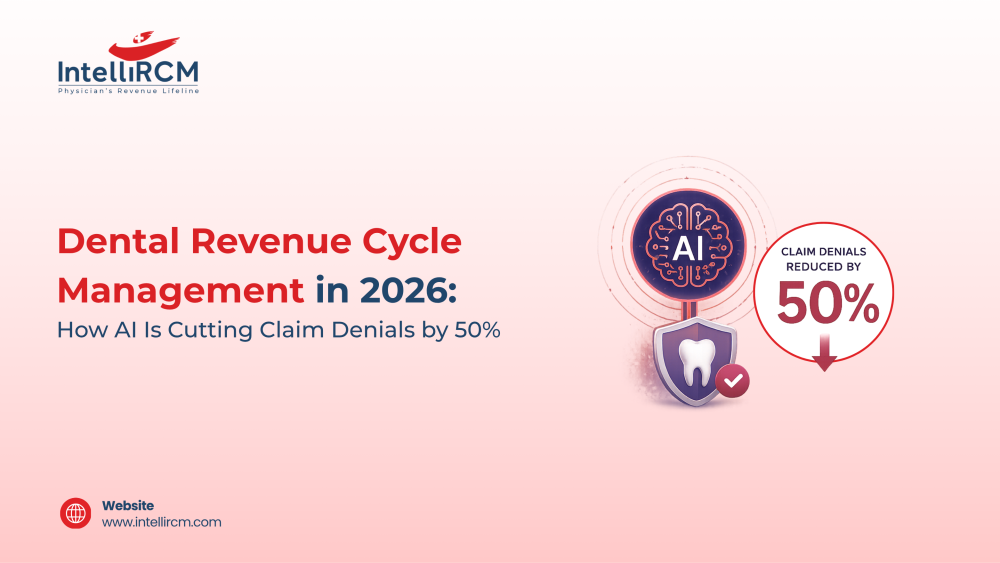
AI is reshaping the way dental practices manage their revenue cycles. See how intelligent automation is helping billing teams catch errors early, reduce denials faster, and recover more revenue with less manual effort.
Read Full GuideDental billing does not have to be a source of stress, lost revenue, or administrative chaos. The 10 tips outlined in this guide are practical, proven strategies that any dental practice can begin implementing right away.
From using the correct CDT codes and submitting clean claims to training your full team and collecting payment at the point of service, each improvement you make compounds over time. Even a modest reduction in your denial rate or a small improvement in day-one collections can add tens of thousands of dollars to your annual revenue.
And if the complexity of managing billing in-house is holding your practice back, remember that experienced dental RCM services providers like IntelliRCM exist precisely to solve this problem. You do not have to do it alone.
Start with one or two changes this week. Build on them. Over time, those small improvements will add up to a billing operation that works as hard as you do.

Maximize your healthcare financial health by adopting AI-driven RCM billing services. Learn why smart automation is now vital for modern revenue recovery today.
Read More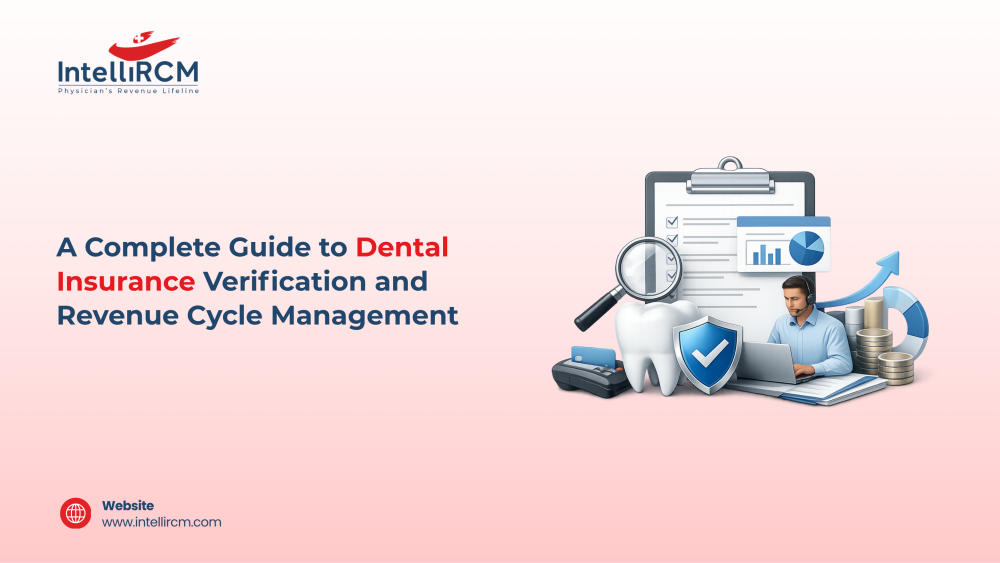
Reduce dental claim denials and speed up payments with proven insurance verification and RCM strategies. Connect with IntelliRCM to grow your practice revenue.
Read More
AI-driven virtual assistants are redefining healthcare revenue cycle management. Reduce claim denials, speed up reimbursements, and cut costs. Optimize your RCM today.
Read More