
 Revenue Cycle Management
 14-May-2026
Healthcare Revenue Cycle Management (RCM) is undergoing one of the most significant transformations in decades. Traditionally, RCM depended heavily on manual workflows, fragmented systems, and large administrative teams to manage billing, claims, and patient financial interactions. This often led to inefficiencies, delayed reimbursements, and high claim denial rates.
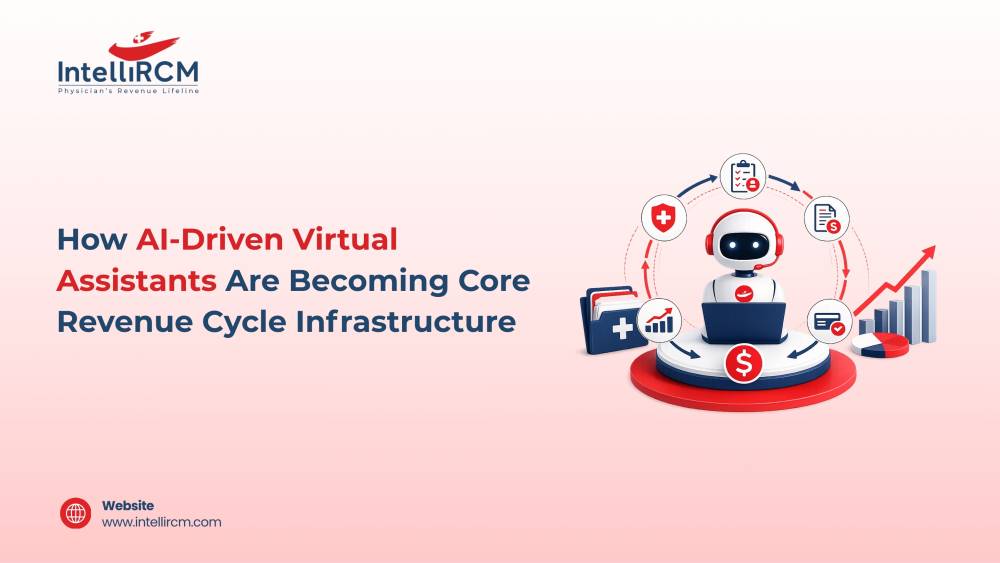
In 2026, the industry is witnessing a rapid shift toward automation powered by Virtual Assistants in Healthcare. These intelligent systems are no longer limited to answering patient queries. Instead, they are actively participating in core revenue cycle operations, improving accuracy, reducing operational burden, and accelerating cash flow cycles.
The integration of Virtual Assistants Solutions is now redefining how healthcare providers manage financial workflows, making RCM faster, smarter, and more scalable.
Virtual Assistants in Healthcare RCM are AI-powered systems designed to automate and optimize administrative, financial, and communication tasks across the revenue cycle. Unlike traditional support systems, they can execute multi-step workflows and interact with multiple healthcare platforms.
These capabilities position Virtual Assistants Services as a critical component in modern healthcare operations rather than just a support function.
The healthcare ecosystem is evolving rapidly, and virtual assistants are now becoming foundational infrastructure within RCM systems. Several key factors are driving this shift:
Modern Virtual Assistants Solutions are now deeply integrated into electronic health records (EHR), billing systems, and payer communication platforms. This integration allows them to operate across the entire revenue cycle, reducing dependency on manual intervention and increasing operational efficiency.
As a result, virtual assistants are no longer optional tools but essential infrastructure supporting medical revenue cycle management at scale.
Virtual assistants streamline patient onboarding by automating appointment scheduling, confirmations, and reminders. This reduces front desk workload and improves patient engagement.
One of the most critical applications is real-time eligibility verification. Virtual assistants verify insurance coverage before services are delivered, reducing the risk of claim rejections and improving approval accuracy.
AI-driven assistants support billing teams by identifying missing codes, correcting errors, and ensuring compliance with payer rules. This significantly improves billing accuracy and reduces rework.
Virtual assistants track claims throughout the lifecycle, identify delays, and automate follow-ups with insurance providers. This improves claim turnaround time and reduces revenue leakage.
Automated communication systems handle billing reminders, payment queries, financial assistance guidance, and Patient Statement Service workflows, improving patient satisfaction and collection rates.
The adoption of virtual assistants in RCM delivers measurable benefits across clinical and financial operations:
Healthcare organizations using Virtual Assistant Services are experiencing a more streamlined revenue cycle with fewer manual bottlenecks and improved financial predictability.
Traditional RCM outsourcing relies heavily on manual processes and human intervention. While effective to some extent, it often lacks scalability and real-time responsiveness.
In contrast, AI-powered virtual assistants offer:
Unlike traditional outsourcing, Virtual Assistants Solutions provide consistent performance, reduced dependency on human availability, and improved operational control.
IntelliRCM's AI-powered virtual assistants handle eligibility checks, claims, and billing communication so your team can focus on what matters most. Build a faster, more accurate revenue cycle starting today.
Virtual assistants enhance revenue cycle efficiency by automating repetitive and time-consuming tasks across departments. They help healthcare providers achieve:
By integrating AI into workflows, organizations can strengthen revenue cycle management services and ensure smoother financial operations.
Additionally, advanced automation improves denial management services, allowing healthcare providers to proactively identify issues before claims are rejected.
IntelliRCM is redefining how healthcare organizations manage their revenue cycles through intelligent automation and AI-driven workflows. By leveraging advanced Virtual Assistants in Healthcare, IntelliRCM delivers end-to-end automation across billing, claims processing, eligibility verification, and patient financial communication.
Its Virtual Assistants Services are designed to reduce administrative burden, minimize claim denials, and accelerate reimbursement cycles. IntelliRCM integrates seamlessly with existing healthcare systems, ensuring smooth adoption without disrupting operational workflows.
With a strong focus on accuracy, compliance, and scalability, IntelliRCM empowers healthcare providers to modernize their financial operations. It bridges the gap between traditional billing systems and next-generation AI-powered automation, enabling organizations to achieve higher efficiency, improved cash flow, and better patient financial experience.
Learn how virtual assistant technology enhances patient engagement, reduces administrative load, and improves revenue. Read more for practical insights.
Read Full GuideThe healthcare industry is entering a new era where automation is no longer optional but essential. AI-driven virtual assistants are becoming the backbone of modern revenue cycle operations, transforming how healthcare providers manage billing, claims, and patient financial interactions.
By integrating Virtual Assistants Solutions, organizations can significantly improve operational efficiency, reduce claim denials, and enhance financial performance. The shift toward intelligent automation is also redefining how medical revenue cycle management is executed, making it faster, more accurate, and more scalable.
As healthcare continues to evolve, virtual assistants will play an even greater role in shaping the future of RCM. Organizations that adopt these technologies early will gain a competitive advantage through improved cash flow, reduced costs, and superior patient experience.
Claim denials are rising fast in 2026. See the billing changes your practice needs to protect revenue, pass audits, and outsource billing to IntelliRCM today.
Read More
Widespread concerns about the cost of healthcare drove the U.S. government to enact the No Surprise Act. While the law helps make healthcare more affordable and accessible, it poses a significant challenge to healthcare providers. It introduced new accounting requirements to a sector buckling under existing regulations.
Read More